Thursday, 10 March 2016

Throwback Thursday #26 - CN Plow Run at Hamilton, ON March 1984

A late-winter storm has called for a plow extra on the Grimsby sub. Here CN RS-18 #3624 pushes plow #55219 eastbound near Parkdale on March 1, 1984. Reg Button photo, author's collection.


Tonight’s Throwback Thursday takes us back to March 1984. We’re at Hamilton, ON on the first day of the month, where we find an eastbound plow run on the CN Grimsby sub near Parkdale. As if that’s not interesting enough, the power for this plow run is RS-18 #3624. Plow runs on the CN in Ontario were synonymous with CN’s bastion of F7Au’s, some of which specially modified for this purpose. As the F’s aged, however, backup snow-fighting power was facilitated by modifying a number of RS18’s and GP9’s with distinctive “snow shields” which stymied snow incursion into the fans and radiators. Interestingly enough, CN 3624 wasn’t one of them. Even more unusual is a plow run on the Grimsby sub – far more typical on CN’s branchline network north of London, the sight of a snowplow on the double track Grimsby sub mainline is indeed unusual (I wonder if CN had any double-track plows left in 1984?). Hamilton is not typically affected by winter storms to the same degree as the Toronto area or southwestern Ontario, but the Niagara peninsula does have a habit of attracting some pretty major snowfalls. So it was likely that somewhere farther east this unusual movement would encounter a bit more resistance than the trip has already dealt the plow. Any way one looks at it, however, it is quite an interesting occurrence – one of “if it hadn’t been photographed, I wouldn’t believe it” trains! Interestingly, the photographer noted “first time on the Grimsby sub” on the slide mount. I don’t know whether that’s accurate or not, but it almost certainly hasn’t been repeated since. CN 3624 itself had a fairly long career, having been built in 1957 by MLW. Aside from a repaint from the CN noodle scheme to the zebra-stripe scheme, it seems that the unit lead a generally uneventful life, reaching the Moncton deadlines by 1990, and likely scrapped shortly thereafter. But for a least one day, it must have been pretty exciting to have been at the throttle in that engine…

‘Til next time,
Cheers,

Peter.

Tuesday, 9 February 2016

A Little Piece of History

The north-facing station sign from the CN location of Rymal, just south of Hamilton, is the latest addition to my railway memorabilia collection.


Prior to last weekend’s train show in Ancaster, ON, I was contacted by a gentleman who offered to sell me the Rymal station sigh that was once located at it’s namesake location on the Hagersville Sub. I couldn’t pass up the opportunity to purchase it and met at the train show with the seller (also a vendor at the train show). Pictured above is the station sign post and the “Rymal” sign that was once attached to it (similar to the Walton Jct sign in John Allen's photo HERE). I’m told this is the north-facing sign that was located adjacent to Stone Church road, at the north siding switch. Considering that I’ve found rather little on the Rymal name (even the Hamilton Library doesn’t have much), I think this is a pretty neat piece. The post has a weathered patina acquired from decades spent out in the open; it features the letters “CNR” on opposite sides, pre-dating the 1961 creation of the modernized CN Rail. The metal sign that said “CN Rymal” is missing (I suspect in a railfan’s memorabilia collection, somewhere) but I believe that the wooden sign predates the use of a metal station sign. My guess would be that the sign and post date from sometime in the 1950’s. Interestingly, the CNR has almost completely faded off of one side and produced a sort of “ghost” lettering; this side is on the opposite side from the bare spot where the station sign was nailed, which likely confirms this as the north-facing station sign as decades in the sun likely faded the painted letters on the south side into history. What am I going to do with the sign? Not sure. I like on the corner of the block so maybe I could put it near the street sign and confuse motorists (I do live near Rymal road). Maybe plant it in the garden? After all, some railfans have lanterns or switch stands on their front lawns. Either option, I suspect, would not be very popular with the authorities that be… But for now, it’s neat piece of history to hang onto that can’t be replaced…

Til next time,
Cheers,

Peter.

Tuesday, 2 February 2016

HO Review: Bowser GMDD SD40-2, CP #6046


The latest addition to my roster, CP SD40-2 #6046, is almost ready for service on the layout. A bit of weathering will complete an exquisite HO model. 


At the Ancaster train show this past weekend, I had the opportunity to pick up one of the new Bowser General Motors Diesel Division (GMD) SD40-2’s, part of their recent release of units matching prototypes purchased by CP, ONT, and BC Rail. I must admit, this was one of my most-anticipated purchases, and I’m glad the wait is finally over! This is not intended to be a 100% complete review, as I may miss a few things, but it should capture most of the locomotive’s highlights.

The Prototype

In 1:1 scale, CP 6046 is a GMD-built SD40-2, rolled out of the London, ON plant in March 1983. Part of CP’s second-to-last order for conventional SD40-2’s (the SD40-2F “Red Barns” followed in 1988), the unit was delivered in the road’s Action Red paint scheme with a small multi-mark adorning the rear of the long hood. Customary of late CP SD40-2’s, CP 6046 is equipped with features including the late-style corrugated radiators, Q-fans (at radiator), external radiator piping, anti-climber on front pilot, and angular traction motor blower duct. Over the years, the unit has undergone minor changes to it’s appearance, most notably a repaint to the solid red Action red paint scheme, as well as the addition of ditch lights on the front pilot. More information can be found HERE.


CP 6049, three numbers away from the my Bowser model, is from the same 1983 build as #6046 and is in the same paint scheme. Remarkably intact after 28 years of service, some updates to its' appearance include frame reflective stripes on the side sill, replacement handbrake wheel and battery box door, new snowplow, removal of the class lights, and weathering which includes some fading, darkening of radiator/dynamic brake/air filter screens and burnt "CP Rail" on the side of the hood. London, ON on 11/06/2011.

 The Model

When Bowser first announced the release of an HO GMD SD40-2 specific for CP, I immediately set aside some of my hobby budget specifically for this unit. I had modelled two CP SD40-2’s in the past (and one of them is almost done by now…) and one thing I realized in researching the required detail parts was the myriad of possible detail configurations on CP’s SD40-2’s. Differences exist in nose length, radiator type, fan type, winterization hatch, snowplow, horn location, radio antennas, front pilot (anti-climber or not), traction motor blower duct, and last but not least, paint scheme. So when I opened the box and took the model out, to say that I was impressed is putting it mildly – from an initial inspection, I was blown away by the level of detail that Bowser put into the locomotive. The first thing I noticed was that the engine was screwed into a plastic base as part of the clam-shell style of restraint in the box; I like this method and think it offers better protection than simply clamping against the top and bottom of the locomotive. A small piece of brake line did separate from the model (I have yet to determine exactly where it belongs), but that’s perhaps not unexpected when the engine has already travelled half way around the world from the factory. I could say that “the model closely matches prototype dimensions”, but since it is already obvious that it does. Instead, I’ll go over some of the more impressive details that Bowser put into the locomotive.

A close-up shot of the cab shows details such as class lights, air hose glad hand detail, builder's plate, and handrail detail.

  • The Dofasco name on the truck sideframes – some might consider this an insignificant detail since it’s usually buried under years of road grime, but I thought this was a really neat feature, one of the things that makes it distinctly Canadian.
  •  The Canadian-style handrails – Many times it is forgotten that the handrails on GMD SD40-2’s is somewhat different than those built at La Grange. Since CP SD40-2’s feature unique upright stairs (to prevent snow accumulation in winter), the handrails follow suit by following a more vertical profile at each corner than US-built SD40-2’s. Likewise, a unique CP add-on are the chain attachment triangular hoops on either end of the engine. This could have easily been overlooked, but again are a signature detail on this model.
  • The Class Lights – not only does the model look nice, but it is detailed inside and out. A great deal of effort went into the electronics on the locomotive (especially sound units equipped with LokSound decoders), one of the most interesting details being the individual white, red, and green LED class lights. I’m glad I didn’t have to solder any of those wires! 
  • The other lights – a number of minute LED’s provide impressively bright lighting on the engine. One thing I was impressed by was that the LED’s for the ditch lights are mounted in the shell, right on the pilot, not lit by “light tubes” or “fiber optics” as some other manufacturers have done. This means that the ditch lights are just as bright as the headlights, not much dimmer as on other models equipped with lit ditch lights.
  • The Graphics – not only is the model detailed correctly, but clearly a lot of effort went into the paint and pad-printing on the model. The lettering, even some of the smaller details such as the “lift here” at the jack pads is clearly readable – the resolution of some of the graphics, such as the builder’s plate, is probably beyond the capability of my eyes to read! Likewise, separately-coloured handrails, handrail stanchions, grab irons, cab interior, and exhaust stack all contribute to the superb appearance of the model.
  • The Motor – I’m told this model uses a new motor for Bowser products, which likely explains the size of the flywheels on the motor shaft. I didn’t measure them, but they appear to be a good bit larger than the old Athearn Blue Box flywheels, which seem to help the model operate quite smoothly. The motor is surrounded by a great deal of weight, which should give the engine plenty of traction.
  • The Wheels – one thing I thought was a nice touch was that blackened-metal wheels were installed on the model. No shiny silver wheels that need painting on this engine! To me, this is one of the details that set this model apart from other high-end manufacturers, or even brass engines. Additionally, Bowser included extra bearing caps in the packaging - CP has a habit of exchanging the enclosed Hyatt-style bearing covers for exposed-cap bearings, similar to freight car bearings where one can observe the rotation of the end cap. Bowser included a set of spare bearing caps so that the unit can be detailed per prototype, if it has received replacement bearing caps. 
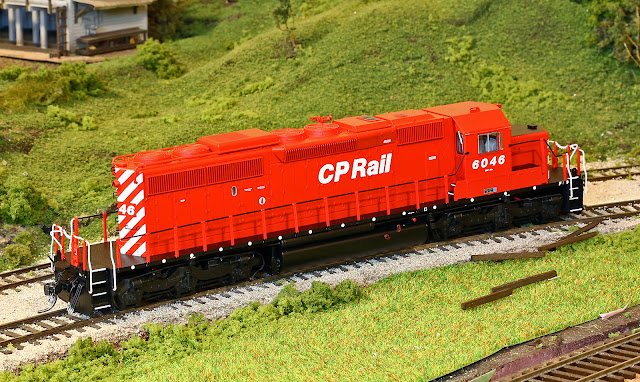
 
This shot of the engineer's side of the engine showcases details such as the Q-fans, external radiator piping, rear pilot detail and waste retention tank, another nice touch.
Two minor things (really minor) caught my attention as minor areas for potential improvement. The first, a detail difference, is that the CP SD40-2’s feature an angled drip rail above the cab side windows. The model appears to have a straight drip rail, which is at most a minor correction. The second is not so much a detail issues as an operational one – the front pilot interferes with the coupler trip pin on the car coupled to it (assuming trip pins have not been removed from one’s rolling stock). This is not an issue unique to this model, but almost any engine that has a snowplow; I first noticed this phenomenon on an Athearn Genesis GP38-2W. My solution on that engine, likely on this one as well, will be to install a long-shank coupler on the front of the engine to avoid contact between the trip pin and the round style rock plow on the front pilot.

Again, this is not meant to be a complete review or any sort of advertisement for Bowser, but it is hard to overlook the massive amount of detail that went into creating one of the most detailed (and one of my most favourite) HO plastic engines anyone has ever produced.

‘Til next time,
Cheers,

Peter.

Thursday, 21 January 2016

Throwback Thursday #25 - Canadian Pacific DT-2 Switcher at Goderich, ON in July 1964


Canadian Pacific DT-2 44-ton centercab switcher #17 work the grain elevators at Goderich, Ontario in July 1964. Except maybe for gloves, it doesn't look like there was much PPE back in 1964! CP's impressive bridge over the Maitland River can be seen in the distance at left. Uncredited Kodachrome from author's collection.

Tonight’s Throwback Thursday takes us back to July 1964 in Goderich, ON, where we find Canadian Pacific DT-2 switcher #17 switching grain boxcars. A seldom-photographed engine, CP owned 14 of these unusual little diesel-hydraulic locomotives, scattered around the system for light switching duties. The engines were built by Canadian Locomotive Company of Kingston, ON from 1957-1960, but were not a Fairbanks-Morse design, as were most diesels that CLC built. Instead, two Caterpillar D-337 engines each contributed 250 hp, routed to the inboard axles of each truck, and from there to the outboard axles by means of crank rods. A rather bold departure from the rest of CP’s diesel roster, the units proved to be somewhat of a pariah, with retirements occurring as early as 1969. Built in 1959, CP #17 replaced 0-6-0 #6275 (noteworthy as the last operating 0-6-0 on CP’s system) , itself surviving on the CP roster until a sale to Cambridge, Ontario boiler and steam energy equipment maker Babcock & Wilcox in 1974. Another sale in 1996 took the unit to Tottenham, ON where it served as a parts source for South Simcoe Railway’s other DT-2, #22. Briefly reunited with one of the few remaining DT-2’s, #17 was stripped of usable parts and eventually scrapped in 2006 once it had outlived its’ usefulness.

While photographs of CP operations in Goderich often feature the small lakefront yard or the adjacent passenger station, the grain elevators seem to have been seldom photographed. The namesake of the 111.8 mile branchline CP used to reach the town, Goderich was important enough to warrant two railroads, CN being the other line to serve the town. Salt, grain, Champion road graders (later Volvo Construction Equipment), and other industries in town contributed to the majority of the railway’s business in the town.  Gradually though, trucks and centralized manufacturing eroded much of the industry served by CN and CP, with the latter abandoning the Goderich subdivision north (west) of Guelph in 1989. In 1992, the competition also pulled out of Goderich, with CN selling the line west of Stratford to new Railtex operator Goderich-Exeter Railway. The Sifto Salt mine located on the waterfront is now the largest industry served in Goderich by GEXR. Changes in grain rates made Ontario grain less favourable in comparison to that grown on the prairies, and many Lake Huron ports including Goderich, Owen Sound, and Collingwood, faced reduced grain volumes (or a complete halt in grain shipments altogether), a problem made worse for the railroads by stiff competition from trucks. Goderich, however, faired better than some other ports, and Goderich Eleveators continues to send grain out by ship primarily to the export market. Both trucks and the GEXR serve the elevators, though modern 4650 CF cylindrical hoppers are a far cry from strings of 40’ boxcars!

Interestingly, both CP #6275 and the former CP steel bridge over the Maitland River survive today. Old #6275 resides indoors at the Huron County Pioneer Museum, never having left the city it served for many years. The bridge is now a part of a hiking trail and offers a unique view of the port and Maitland River.

A Google Streetview image in approximately the same area as our subject photo. This elevator is no longer served by rail (trucks only), though the elevator in the distance still has rail service.

A Google satellite shot of the port of Goderich, as well as the town's unique octagonally-arranged historic downtown core. The old CP line extends in an arc down and to the left from top-center, while the ex-CN (now GEXR) line extends left-right across the image to reach the Sifto Salt mine at left.


‘Til next time,
Cheers,

Peter.