Saturday, 3 August 2019

CN Rymal Pt. 12: Caboose Variety Part 1

Like most secondary operations, the former H&NW line would be home to CN’s well maintained wooden caboose long after modern steel end of train cabins had been introduced. Time did eventually catch up with the legendary wooden vans (van; ‘Canadian’ for caboose) and starting in the mid 1970’s they began to be supplanted by steel bodied successors. While it’s possible that a Hawker Siddeley Transport (HST) built caboose did traverse the line, it was the well-known Pointe St. Charles (PSC) that singularly plied the line until the end of service in 1993.
Details of the PSC caboose are well-known; between 1970 and 1977 CN’s Montreal based repair/rebuild facility would transform some five hundred and forty eight 1937 built 472000 series forty-foot boxcars into very well appointed crew cabins (CN 79350 – 79897). Exterior features included;
·        Welded cupola with upward tilted end windows equipped with windshield wipers
·        Large carbody end picture windows equipped with windshield wipers
·        Large carbody side picture windows
·        Red/green marker lights on roof end
·        Clear end sill mounted backup lights
·       Axle driven generators and battery boxes
Above: CN 79444 was a member of the first group to be constructed in 1970. Note the horizontal ductwork running parallel to the roof placing the smoke stacks against the faces of the cupola. The concept was to provide the crew with unobstructed vision. Unfortunately, the offset geometry did not draft well and later construction placed the smoke stacks directly above the oil fire heaters. No. 79444 would be transformed into International Service caboose No. 78100 in 1982 and receive a yellow painted cupola. Still on CN’s equipment roster; today CN 78100 is most likely a ‘rider car’.
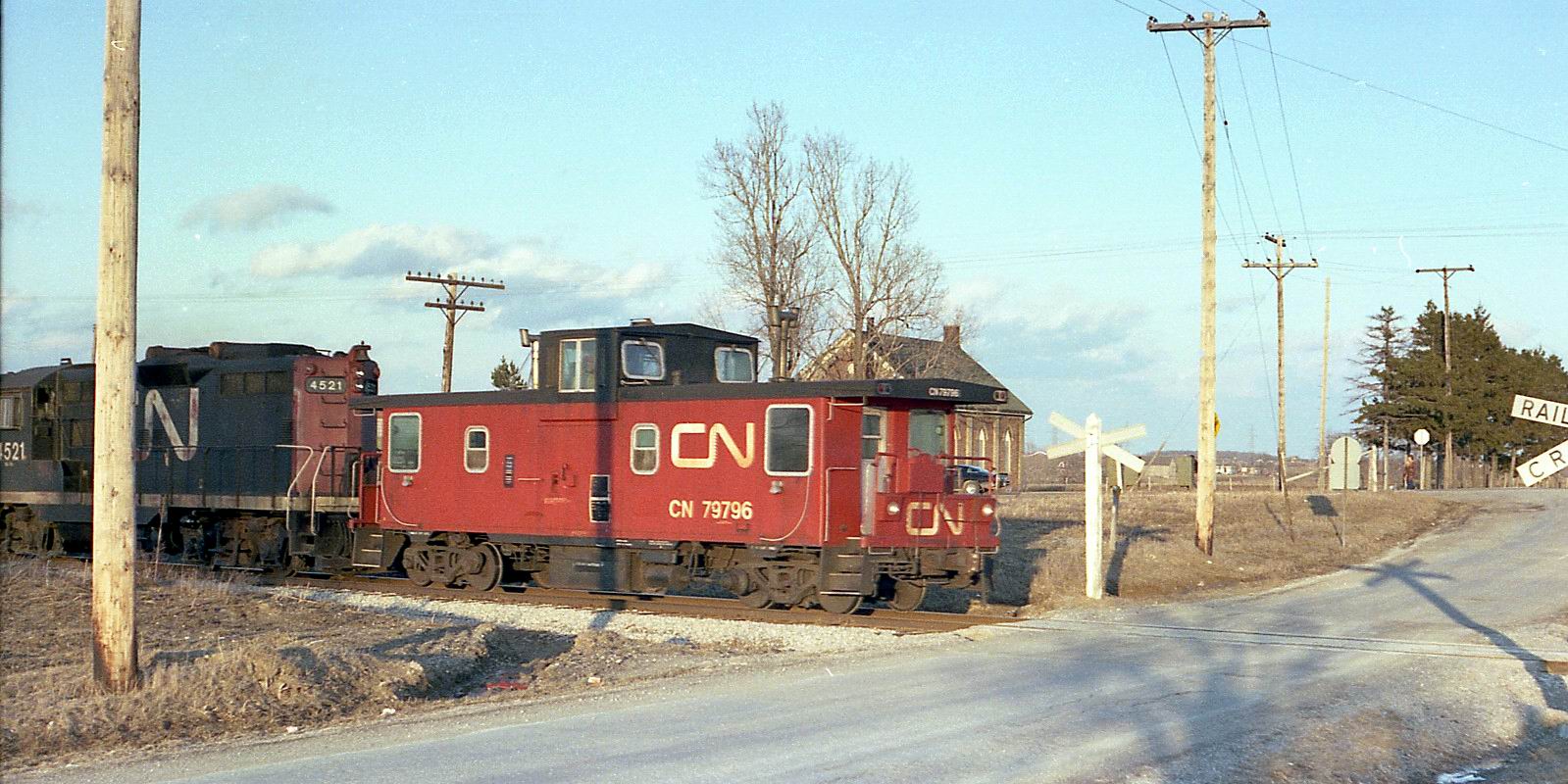
Above: CN 79796 was delivered from PSC in 1975. Propelled by GP9 Nos. 4521 and 4560, opposite to its intended deployment, the orange and black cabin is shown leading a caboose hop southward from Rymal in the early 1980’s. Despite having the opportunity to conduct a run around on the CO-OP siding, the crew has elected to save time and return to home base earlier in the evening. CN 79796 would remain on the roster until June of 1995.
Above: CN79825 would emerge from PSC in October of 1975 and remains active today. Given their origin, the PSC cabooses combined contrasting construction methodologies; riveted carbody sides from 1937 and all welded roof/cupola assemblies from the 1970’s. Note the reconfigured smoke jack assembly; a segment of rectangular ductwork positioned at a right angle places the smoke jack centrally on the roof. The opposite side smoke jack is positioned directly above the space heater. CN GP9RM No. 4107 (ex 4123; GMD 9/1957) will lead the consist south on this mid-summer evening.
Above: CN 79866 was constructed in 1977. Based on a guess of a spring 1978 photo date the shiny orange and black crew cabin is but a few months old. Note the positioning of the smoke jacks and the air vent directly below the ‘6’, not included in prior construction (see CN 79444 above). Sadly, CN 79866 was destroyed in a rear end collision on the Dundas subdivision on May 4th, 1984. CN GP9 No. 4513 was also destroyed (http://www.railpictures.ca/?attachment_id=17206). Tragically, a crew member in CN 79866 suffered a severe leg injury.
Above: CN 79869 was also delivered from PSC in 1977. Application of the large carbody picture windows was noteworthy; their size was unprecedented, certainly in wooden caboose construction, and contrasted with US small window practice which acknowledged security and vandalism concerns. As with the cupola windows, the carbody end windows were tilted up slightly to reduce glare. CN 79869 was renumbered to CN 77018 in 1995 and would remain active as the Kamloops Auxiliary caboose and finally as the ‘Western Canada Engineering Work Car’ until 2006.

Saturday, 25 May 2019

CN Rymal Pt. 11: Freight Cars Part 2 - Shaw Pipe Protection

In addition to the double ended siding at Rymal, two other spur tracks served local area industries; Penn Lumber and Shaw Pipe Protection – see Rymal Part 4 (http://rymalstation.blogspot.com/2017/11/cn-at-rymal-part-4.html) While the Rymal Station stop trackwork dated from the 1870’s inauguration of passenger service, most likely the additional sidings were constructed in the late 1950’s as the diminutive local  industrial base expanded. This month’s installment will focus on railway operations related to Shaw Pipe Protection.
Hamilton was and is known as the ‘Steel Capitol of Canada’; both the Steel Company of Canada (Stelco) and Dominion Foundries and Steel (Dofasco) once operated major facilities on the lakefront. Today, only AcelorMittal, owner through acquisition of Dofasco, continues to produce steel. Operations at the recently renamed back to Stelco instalation are currently limited to finishing (galvanizing) and coking.
In its prime, Stelco had several affiliated area operations including Stelpipe located in nearby Welland. While the facility manufactured a variety of pipe geometries, their staple was oil & gas pipe intended for major pipeline construction projects. Underground pipe requires a protective coating, a process performed by Shaw Pipe Protection. Formed in 1958, Shaw Pipe Protection Limited would initially establish coating facilities in Hamilton and Toronto. Proximity to pipe supply together with rail access combined to make the local hamlet of Hannon an ideal location for the Shaw facility. A thriving enterprise for some thirty years, the level of activity would ebb, and flow as major pipeline construction projects were launched and completed. In 1984 Shaw secured a major supply contract related to a large-scale pipeline construction project in western Canada. Due to limited siding capacity it became necessary to switch the Shaw siding twice a day; in the morning by the daily way freight, in the afternoon by an ‘Extra’ job dispatched from the south. ‘Extra’ weekend switching was also required. Following the lifting of rails in 1993 activity at the Shaw plant began to decline significantly. A further blow was dealt in 2005 when Stelpipe was sold off as part of Stelco’s insolvency. Lack of rail access together with potentially unstable pipe supply resulted in Shaw having virtually no opportunity to participate in major pipeline construction contracts. As a result the facility was essentially doomed; overall operations would cease around 2007. Several years ago the entire infrastructure was razed and the vacant land remains a brownfield site. While no development has subsequently taken place on the former Shaw property it appears that the process of soil remediation is nearing completion. Still a global enterprise, information on what Shaw became part of, go to https://www.shawcor.com. Additional information on the history and development of the Shaw corporation can be found within the obituary of founder Leslie Earl Shaw; http://nationalpost.remembering.ca/obituary/leslie-shaw-1927-2007-1065386407?fbclid=IwAR2eaQy2S0Hct4seJ_TiTlv3-OMFBBdJd0G4T4w1kVdaYwgXSUbjjkUaQnw.
Above: CN 667407 is a 62 ft. flatcar built by National Steel Car (NSC) in 1974 as part of series CN 667275 – 667410. The payload consists of 24-inch pipe protected by a 2-Layer Polyethylene Coating known as ‘Yellow Jacket®’. Yellow Jacket® consists of a continuous sheath of high-density polyethylene cross-head extruded over a rubberized asphalt adhesive. Introduced over half a century ago the protective layer can withstand routine handling and allows for field bending in temperatures as low as -30°C. Note the adjacent CN gondola loaded with pipe to be coated.
Above: CN 668238 is an 89 ft. flatcar built by Hawker Siddeley Transportation (HST) as part of a three hundred car lot (CN 668000 – 668299) in December of 1975. Compared to the payload above, the pipe appears to have received some type of asphalt or perhaps rubber-based coating. For pipe protective coating alternatives, go to; https://www.shawcor.com/pipe-coating-solutions/integrated-solutions/pipe-coating/anti-corrosion-protection
Above: CN 557353 is a 52’ – 8” combination door boxcar built by National Steel Car (NSC) in January of 1973 as part of series CN 557300 – 557439. Most likely this car is being used to bring in raw materials related to the coating process; blast grit media, plastic pellets (bagged), etc. Despite only being eleven years old, the car appears to have been recently repainted.
Above: CP 341485 is a 52 ft. low side gondola built by Eastern Car Company in 1954 as part of five hundred car build lot (CP 341000 – 341499). Note the converted friction bearing trucks on both this car and the coupled CP gondola. Given the mandated AAR maximum service life of forty years (cars built prior to 7/1/1974), CP 341485 would only be eligible to continue in service for another decade. Due to the proximity of Stelpipe in nearby Welland, a greater amount of pipe was delivered to Shaw by transport truck rather than flatcar or gondola. Local trucking company ‘Tallman Transport’ maintained a service contract with Stelpipe for several decades.


Sunday, 10 March 2019

CN at Rymal Pt. 10: Motive Power Part 5.

Employing the inauguration of passenger service date of 1873 and the lifting of rails date of 1993 as book ends, Rymal would be witness to some one hundred and twenty years of motive power evolution. Steam locomotive wise, the technology would progress from diminutive so called ‘American’ 4-4-0’s to CNR’s preeminent ‘Northern’ 4-8-4’s. Late in steam, the everyday freight or mixed became famous for ‘Moguls’ and ‘Ten Wheelers’. To climb out of the lower city, when warranted by tonnage, the light weight Moguls were either doubled up (sometimes tripled!) or aided by ‘Mikados’. While the former H&NW line may not have been home to 4-8-4’s for the workaday traffic, superstar excursion performer Northerns 6167 & 6218 each plied the line in the 1960’s.
As previously mentioned, my attention (i.e. take photos) to the line began in the mid 1970’s. Motive power at the time was exclusively the smallish, gnarly appearing SW1200RS. Wooden cabooses were still the order of the day. The interest and experience would consume almost a decade and a half. GP9RM 4107 pictured below would be the last unit I would capture on film (why did I shoot B&W for so long???!!!). Nevertheless, I’m more than grateful to have had the opportunity to capture as much Rymal activity as I did over the years.
Above: CN GP9RM No. 4107 was constructed by GMD London in September of 1957 as GP9 No. 4123. Remanufactured by PSC in 1984, remarkably the veteran unit is still in service at age sixty-two! With no turning facility at Rymal the freshly rejuvenated unit will venture south back to home base long hood forward. Guessing that the crew has left the unit idling to go and have dinner on this pleasant appearing evening of July 27th 1989.
CN GP9 No. 4569 coming and going. Unfortunately, I did not take the time to date some of my earlier material. However, there are some time frame clues. The car in the background is a 1980 Plymouth Horizon TC3, my first set of wheels. Need for my own form of transportation was generated by my entering Engineering at McMaster University in the fall of 1979. Judging by the remnants of snow, the season would appear to be late spring, most probably in 1980. The relatively short consist is shown sprinting across Nebo Road, about to cross Twenty Side Road. Today the right of way has been transformed into the ‘Chippewa Rail Trail’ that will eventually connect Hamilton with Caledonia. Note the well-maintained track structure, permitting No. 4569 enough speed to generate conspicuous exhaust blow back/dissipation. Constructed by GMD 11/1957, No. 4569 would be transformed in 1990 by PSC into slug No. 245 and is still listed on the active roster. The HANNON SCHOOL structures shown in the background still exists as IBEW offices.

Wednesday, 20 February 2019

CN Stuart Street Locomotive Shop - Motive Power Variety

In the 1960’s, with its convenient location (positioned more or less centrally among the cities of London/Niagara Falls and the metropolis of Toronto), the Stuart Street facility was always home to a diverse bastion of diesel locomotives. Numerous switchers, of course, to serve the yard and vast water front industrial base, road switchers to serve the branchline south to Lake Erie, as well as passenger units deployed on the Oakville subdivision Lake Shore commuter trains. Recall that this was, for the most part, pre MacMillan Yard/diesel shop and pre GO Transit. Drop pits in the shop building facilitated government mandated ninety-two day inspections and protection (spare) units or units in need of minor repairs could easily be accommodate within the sizeable amount of real-estate. As previously mentioned, the infrastructure would evolve and diminish in importance over time. Eventually, all of the locomotive maintaining functions would be transferred to other locations and the infrastructure razed.


A sunny morning in August of 1966 finds the backyard of the Stuart Street diesel shop crowded with a marvelous gathering of GMD/MLW built motive power. Left to right; SW1200RS 1229, FP9 6513 + sister FP unit, SW1200RS 1315 and S4 8167, among other unidentified brethren. Nos. 1229 and 8167 are in their as delivered schemes while 1315 and 6513 sport the famous 1961 modernization dress. Aside from the MLW interloper this image could very well serve as an advertisement for General Motors with the Morency Orange panel truck prominently featured in the foreground! Today we could photo shop out the S4!

A scene that would cause an MLW Salesman to smile from ear to ear! Not a competitive intruder in sight! Present that day; RS-18’s No. 3114 (blt 10/59), Nos. 3126/3129 (blt 12/59), and S-3 No. 8468 (blt 1953). Retirements from the RS-18 build group (3100 – 3129) would commence in 1982 and by 1975 all of the S-3’s would be gone.
Changing of the guard! A pleasant Halloween day finds a transitional assortment of all GMD power on property. Left to right; GP40-2L(W) 9436, GP9 4524 and GP9RM 4116/unidentified GP40-2L(W). No. 9436 (blt 6/74) would be cast off in 2000 becoming TPW 4053, No. 4524 (blt 12/56) would be transformed by PSC (1991) into GP9RM 7028 and is still active, while No. 4116 was constructed as GP9 4131 (blt 10/57) having been remanufactured by PSC in 1984 and is also still active. Note that in the intervening years that the black horizontal fuel storage tank has been replaced by a trio of silver vertical tanks.


Friday, 25 January 2019

CN Rymal Pt. 9: Freight Cars Part 1


The siding at Rymal was part of the original construction of the Hamilton and Lake Erie Railway, facilitating the first station stop above the escarpment. Following the last run of mixed train M233 in 1957 the small station was boarded up and the former H&NW line would be freight only its remaining thirty-six years. Local area residents recall that the quaint station structure was not razed until the mid 1960’s.
Overall, Rymal siding would see well over a century (1870 – 1993) of continuous use. In the diesel era daily way freights departing from Stuart St. Yard deposited waybilled cars on the double ended siding and also employed the parallel right of way to stage cars for delivery to the industrial sidings added for Shaw Pipe and Penn Lumber (see FLASHBACK CN Rymal Pt. 4). Following the damage to and subsequent removal of the Stone Church Road overpass (see FLASHBACK CN Rymal Pt. 2) in 1987, the siding was needed as a run around track for train movements dispatched from the south to be able to return to home base.
As previously noted, local development in the form of a construction material distributor breathed some life into the line, albeit very late in the game. The increase in activity was somewhat politically related. On October 4th 1987 the original Canada-United States Free Trade Agreement (FTA) was agreed to in principle. One of the benefits of the accord is documented in this post.
BN 621842 is a 60’ – 8” I.L. (Inside Length) bulkhead flat car built by Greenville Steel Car Company in April of 1977. Greenville Steel Car (GSC) was a historic builder located in its namesake hamlet in western Pennsylvania. In 1986 GSC was acquired by Trinity Industries and manufacturing at the home location was shuttered in 2000. The wide flat expanse behind the car offered ample space for local enterprises to off load all manner of freight equipment.
BCIT 16705 is a 52’ – 8” I.L. bulkhead flat car built 12/1973 by Hawker Siddeley Transport (HST) located in Trenton Nova Scotia. The bundles of lumber are labelled for West Fraser. West Fraser Timber Company Ltd. (www.westfraser.com) is still a thriving enterprise, and still employs the same corporate insignia. Technically, the BCIT reporting mark implies that this flatcar is not permitted to make domestic moves. As this is long before the FTA, either the lumber originated in the US, or a duty violation has occurred. Note the displaced bundle bands; in both directions!
CN 603147 is a 52’ – 8” I.L. bulkhead flat car built 1/1975 by HST. As the wrapping on the lumber bundles is labelled ‘BC RESOURCES’, the origin of the payload is not a mystery! Note that the middle two rows are hard against the left-hand bulkhead. No doubt hard coupling related!
BN 621842 is a nominal 100 ton capacity (263,000 lbs total Gross Rail Load) car with a load limit (LD LMT) of 183,200 lbs. This would translate into a payload of approximately 3,100 sheets of drywall. Note that to minimize any potential damage due to shifting of the payload, dunnage has been inserted between the bundles of drywall to force them tight against the bulkheads. Damage is further mitigated by the fact that this car is equipped with End Of Car Cushioning (EOCC).
DWC 605628 is a 52’ – 8” I.L. bulkhead flat car built 11/1973 by CN Transcona. The LD LMT of 161,000 lbs would translate into approximately 2,800 sheets of 4’ x 8’ ½” thick sheets of drywall. Note that the top of the payload is well below the Inside Height (I.H.) of 11’ – 1”.
TTPX 81430 is a 60’ – 7-1/2” I.L. bulkhead flat car built by Bethlehem Steel Car (BSC) 11/1975. Increasingly, US based freight cars appeared at Rymal loaded with American product.
TTPX 82394 is a 60’ – 7-1/2” I.L. bulkhead flat car built by BSCar (BSC) in 1980. The load is labeled ‘TEMPLE – EASTEX’; a paper/building products company, now part of International Paper.


Tuesday, 20 November 2018

CN Stuart Street Locomotive Shop - January 28 1990

By far the most popular first generation locomotive home to CN’s Stuart Street Yard over the years was GMD’s immensely versatile SW1200RS. With Hamilton’s enormous industrial base and corresponding spider web of sidings there was always plenty to keep the units fully occupied. No. 1311, built 1958, would be sold off by CN to the Ohio Central RR in 1994. In a curious twist of fate the gnarly looking unit would eventually return to Hamilton to serve new operator RaiLink, albeit mostly as a parts source.
Delivered in April 1960, No. 1359 would leave the roster in 1999 and in similar fashion serve replacement operator RaiLink. Enjoying much better fortune, No. 1359 would ultimately be acquired by railway services supplier Cando, becoming CCGX 1006, and is still active.
CN GP9 (GMD 1/1959) No. 4276 was constructed as a so called ‘light weight’ unit intended for use on lower capacity branchline trackage. The combination of small capacity fuel tank and and Flexicoil style trucks reduced total mass by as much as nine tons. While the Flexicoil trucks appear to be the same design as those fitted to SW1200RS’s, the wheelbase is not the same; 9’-0” vs. 8’-0”. In 1993 No. 4276 would be transformed by AMF into GP9RM No. 7082 and is still active.
Some forty-four years on, CN GP40-2L(W) No. 9468 (GMD 7/1974) is still active. No. 9493 (GMD 9/1974) would be sold off in 2007.

Sunday, 7 October 2018

CN at Rymal Pt. 8: Motive Power Part 4.

CN F7Au 9172 is shown in A-B-A form along with F7Bu 9196 and F7Au 9169 approaching Nebo Road 4/12/1986. No. 9172 was originally constructed as F7A No. 9072 by GMD London in August of 1952. Rebuilt by CN’s Transcona (Winnipeg) Shop in December of 1973, the venerable unit would be retired and removed from service in 1989. Note the well maintained right of way.


By far the greatest claim to fame for the former H&NW line would have to have been the late era ‘Covered Wagon’ period. Rumour of the day was that the local CN motive power superintendent had requested the venerable units for the dedicated service. With limited switching requirements, the reduced visibility nature of first generation cab units was not of concern and the old soldiers were well suited to the daily run from the lower city in Hamilton to Stelco’s satellite location in Nanticoke.  My recollection was that the run (Train No. 725) was daily and split monthly between CN and CP. Thanks to the H&NW surveyors, the National system operators enjoyed a much more favourable, almost direct, route end to end, albeit one way. Due to Hamilton city dweller concerns CN agreed not to send loads northbound through the heart of the city along Ferguson Avenue. The return path from Nanticoke was via Brantford along the Dundas subdivision. CP had a much more circuitous path through Brantford and Waterford. The consist was essentially that of a unit train of sixty foot CP/CN (667 series) flat cars fitted with specialized steel slab supports. On occasion, regular freight waybilled to the same end points would be added to the head end.
No. 9172 is shown crossing Nebo road 4/12/1986. Not needing to be turned in A-B-A geometry, the pioneering form diesels were well suited to the point to point service. In overall geography, the Hamilton/Nanticoke/Brantford/Hamilton orbit formed a loosely shaped triangle; adding a second caboose facilitated a quick change in direction at all three points.
Same train, same day, different photographer! No. 9172 is shown alongside the St. George’s Anglican Church Cemetery (on the right hand side). In the background, also on the right, is the Ancaster CO-OP siding along with the years ago abandoned concrete grain silo complex. While the former H&NW/CN right of way was converted to a ‘rail trail’ in the mid 1990’s, all of the structures in the background are still extant. The weather trodden silos still stand guard, and the former Ancaster CO-OP complex has been expanded and repurposed as a Home Hardware location. As part of amalgamation the City of Hamilton assumed responsibility for the burial site in the former hamlet of Hannon. Today this view is completely obscured by wildly unkempt shrubbery.
Having surmounted the Niagara Escarpment and crested the rise (see below) the engineer at the controls of Nos. 9169/9196/9172 has elected to throttle up his consist on the approach to Rymal Road; the flashing warning lights have stopped all traffic rendering the transportation mode intersection clear. Apparently the sun gods were not all that enthused about the presence of the legendary motive power! No. 9169 was built by GMD London 6/1951 as F7 No. 9042 and converted by CN Transcona 10/1973. Retired from service in 1988 the ‘Covered Wagon’ was donated to the Central BC Railway and Forestry Museum located in Prince George. F7Bu No. 9196 was built by GMD London 8/1951 as F7B No. 9053, converted 9/1973, and removed from service in 1988. All of the F7Au/Bu’s received rebuilt 567BC prime movers upgraded to 1,750 HP.
No. 9169 is shown with the entire consist in view. Note the hogback nature of the terrain and the encroaching housing on the right. Not surprisingly, horn blowing was very unpopular!