Wednesday, 25 January 2017

Weekend Project – Athearn Tank Car “Repaint” (100th Post!)


Over the weekend I turned an Athearn RTR UTC 30,000-gal tank car that was originally decorated for DODX into one decorated for Procor (PROX). 


Lately my free time has been reduced a bit due to work demands, so I thought I’d attempt more small projects that I could reasonably accomplish in the span of a weekend. This past weekend I wrapped up the first of what will hopefully be a series of regular updates on this sort of thing. And, as it turns out, this is my 100th post - how time flies!

This week’s project involves redecorating an Athearn RTR Union Tank Car prototype 30,000 gal general purpose tank car. I say redecorating because I didn’t actually repaint the car. Instead, I took a ready to run model that was painted for the US Department of Defense (DODX) and used a Badger air eraser to scrub off the unwanted lettering. The air eraser is essentially a small grit blaster that can use baking soda or aluminum oxide as a blasting media (I use baking soda, it’s much cheaper than aluminum oxide). I carefully masked the areas to be removed, which allowed for preservation of most of the car’s original finish. I specifically chose the DODX car to start with as it had substantially less graphics to start with compared to other paint schemes of the same car. Also, it’s somewhat less desirable, so it was much cheaper to buy than some of the other RTR schemes.

After masking the areas to be removed, I blasted off the unwanted lettering outdoors. Doing so does take a sizeable air compressor due to the amount of air required, at relatively high pressure. After I was done, I rinsed the car with water and let it dry overnight. I then used Microscale’s set 87-1466 (Procor/PROX, Various Tank Cars) to reapply the desired lettering. The set is a great improvement over some of their previous offerings for Procor equipment, but still contains a number of inaccuracies. Using the air blaster, I was able to preserve some of the original graphics such as the “2 INCH HF COMP SHOES” on the side sill and the COTS decals. Lettering was pretty straightforward, using prototype photos found on Chris Vanderheide’s Canadian Freight Car Gallery website. I found a car only two numbers away; I chose PROX 44815 since the number was already aligned in the decal set and wouldn’t require any splicing of individual digits. In prototype, the car is used to carry condensate, essentially a thinning agent used in crude oil pipelines to improve viscosity. The real-life car was built in 2007 at UTC’s now-closed East Chicago, IN plant, and is one of many so-called “short GP30’s” in the fleet (General Purpose, 30,000-gal capacity, less than 60’ in length over pulling faces).  I enjoy decal work since it’s easy to see the results of one’s work, and in this case, pretty quick; the car was decaled in less than an hour. After decaling I used Testor’s gloss coat to seal the decals to the car. I will eventually weather the car lightly, as I model up until 2010, so the car would still be relatively clean and shiny in my modeling era.

‘Til next time,
Cheers,

Peter.

Monday, 5 December 2016

HO Model Review - Walthers Mainline 4650 CF Cylindrical Grain Hopper

Okay, time to get back to something actually model railroading-related. I hope to have more HO-themed articles in the next few weeks and less 1:1 scale posts, not that there's anything wrong with real-world railroading, but the intent for this blog was to be primarily about 1:87 scale railroading. Progress on the layout and various HO locomotive projects has been slow, but I have a lot of things "nearing completion" I hope to feature in the near future.

Walthers' recent Mainline-series release, the so-called 59' Clindrical Grain Car, produced in droves in prototype by Marine Industries.


Anyway, with the relatively-recent release of Walther's so-called 59' grain hopper, I was keenly interested to get my hands on one and see what the model would be like. No doubt this would car would have a tough act to follow in that Intermountain has cranked out models of the same prototype for years. Walthers' Mainline series is their budget-minded line of less-detailed but more affordable products (such as it is today with prices subject to fluctuations in both the US and Canadian dollars), so admittedly, expectations weren't that high to begin with. This is not intended to be a A-Z review, but rather a narrative describing things Walthers got right and things they got wrong. 

The first thing I noticed about the car was the price - retail is $29.98 US, which works out to about $40 CAD, plus tax. For a budget car, that's a bit steep, especially when the far better-detailed Intermountain version of the same car can still be found without much difficulty at train shows for $30 or less (same paint schemes, too). The car comes well-packed in a somewhat-larger-than-necessary box with a plastic two-piece shell holding the car in place. One thing that was known when the model was announced was that it would come with plastic "end cage" (roofwalk supports and grab irons) detail, and plastic roofwalk. While this does solve the common problem of etched-metal roofwalk warp, the trade-off is a noticeably-thicker profile. Admittedly, if you view the car at a 90-degree angle, it's not too bad, definitely better than the old Athearn blue-box details, but as soon as one sees the car at an angle, it's easy to see just how thick the "engineering plastic" is - pretty thick. On the B-end, the brake dear is present and reasonably-well done, but the plumbing connecting the brake components again suffers from chunky-plastic syndrome. That trait further extends to the grab irons and stirrup steps. One thing done fairly well (among others) is that the top hatches are relatively well-detailed, and apparently more reliable than the Intermountain version (I can't seem to keep those hatches in their hinges). Another thing done fairly well are the brackets supporting the roofwalk along the length of the car. The car comes equipped with Walthers free-running 100-ton trucks and Kadee-like metal couplers. Early tests indicate that the Walthers version of the car doesn't suffer from the common problem the Intermountain cars faced wherein the the inboard wheelsets on each truck contact the brake piping detail underneath the car, sometimes leading to derailments. 

A side view of the car reveals a noticeable gap between the side sill and the hopper sheets, most prominent at the middle of the car.


A couple flaws, at least on this particular sample, serve to detract from the car's overall appearance. The first and more obvious, there is a noticeable gap in the seam between the car's side sill and the hopper sheets. It appears that Walthers chose to cast these as separate pieces, and the fit-up between the two leaves a bit to be desired (and would likely be difficult to correct). The second issue is with the graphics; while generally well-executed, a few spots had fuzzy or even blurry contrast between the two colours, most notable between the yellow and brown, but also between brown and black at the BL-corner of the car. A further, more subtle detail, is that the prototype car has 9 weld seams between the hopper sheets, while the model has 12; again, this is not a rivet-counter's car, but is something that could have been accounted for at the factory prior to production. 
Note the fuzzy colour separation, particularly at lower right between yellow/black, yellow/brown, and at the stirrup step, between black and brown.

At anything but a straight-on view, it's hard to overlook how thick the engineering-plastic components are, particularly the brake piping and handrails between end ladders. Also note that the crossover running board is void of any texture.

A top-down view of the roofwalks illustrates the size and coarse nature of the roowalk grid pattern.


In short:

Pro's:

  • It closely matches prototype dimensions (well, it is a scale model...)
  • Tracks well
  • Some elements are well-executed such as top hatches and roofwalk supports
  • Lettering is generally sharp
Cons:
  • Sloppy fit-up results in gap between side sill and hopper sheets
  • No way to hide how thick the plastic components are, such as roofwalk, end cage details
  • Sloppy paint application in several places
  • Wrong number of hopper sheet weld seams
  • For what it is, relatively high price

This isn't meant to be a knock against Walthers - in truth, they have done some incredibly well-executed models such as the 52' bulkhead flatcar. In this case though, I'm not sure what they were aiming for, offering a middle-of-the-road model that has already been done in much better quality, for nearly the same price (there is a price difference between a new Intermountain version and the Walthers', but not what I'd expect given the detail differences). Aside from being a rerun, the execution of the model leaves a fair bit to be desired in several areas, so it appears that Walthers was intent on offering "something" to the budget-minded modelling crowd, but may have only been interested so long as profit margins allowed. While the poor fit-up and paint may be exclusive to this single sample (doubt it), the fact is that other areas such as the roofwalk are hard to overlook. As food-for-thought, Scale Trains recently, with their Operator line, offered an entirely new model (never before made in HO) with better execution and at a substantially lower price; thus it is possible to do a budget car well. 

Verdict: I'm sticking to my Intermountain version. 

Hope this review helps some potential buyers,

'Til next time,
Cheers,
Peter.

Thursday, 1 December 2016

Throwback Thursday #31 - CN Goes to Kansas City in 1977

We're in Kansas City, KS, on August 4, 1977, and observe a rather unorthodox consist moving around the west end of ATSF's Argentine yard. Former passenger service U30CG is joined by CN "4115" (GP40 #4015 cleverly disguised to avoid a numbering conflict with with its' lessor), and GP39-2 #3626. While the two more interesting units have long faded into history, the old ATSF 3626 survives as BNSF 2791, and even still wears it's proud ATSF colors (as of February 2016). Uncredited Kodachrome, author's collection.

Tonight’s Throwback Thursday takes us to Santa Fe’s Argentine Yard in Kansas City, KS. It’s August 4, 1977, and we’re at the west end of the yard where we find an unorthodox consist that includes ATSF 8002, a rare U30CG, CN “4115”, a GMD-built GP40, and ATSF 3626, a GP39-2. Interestingly, both CN and ATSF were known for their fondness of six-axle cowl units – CN ordering Bombardier HR-616’s, GMDD SD50F’s and SD60F’s, and GE C40-8M’s, and ATSF acquiring a fleet of new F45’s and FP45’s, U30CG’s, and used SDP40-2F’s from Amtrak (traded for a number of switchers and CF7’s). The U30CG is perhaps a bit more special than the other cowls though, one of only six delivered as ATSF 400-405 in November 1967. Looking sharp in their silver and red Warbonnet paint, their passenger train careers were cut short in February 1969 when a U30CG derailed while leading the Grand Canyon Limited at Chillicothe, IL. The derailment, at least partially, was attributed to the design of the U30CG – a fate the SDP40-2F would later share – and the units demoted to freight service. This meant a repaint, and the standard blue and yellow freight colors now cover the fluted stainless side panels. Evidently, the Santa Fe was short of power in 1977, as evidenced by the CN GP40 in the consist. Actually, the middle unit is CN 4015, temporarily renumbered to avoid a number conflict with ATSF’s fleet of SD39’s at the time also numbered in the 4000-series. CN was no stranger to leasing spare units, and throughout the late 1970’s leased locomotives, primarily GP40’s, SD40’s and even some six-axle MLW’s, to Conrail, ATSF, and L&N. Interestingly, the likelihood that this consist could be repeated would be short-lived. The oddball GE would be traded back to its builder three years after this photo on an order of B36-7’s, meanwhile the GP40 was leased to L&N in 1978. It would eventually be retired by CN by 1998 (likely earlier), and presumably scrapped. Today, the former ATSF 3626 soldiers on as BNSF 2791, interestingly still in the classic ATSF blue and yellow paint scheme as of February 2016 (!). 

The photo below was taken the day after the photo above, ironically, near Canadian, TX. We again see the same cowled U-boat and CN visitor, paired this time with U36C #8789 and a GP20. It seems the ATSF was intent on getting the most out of the borrowed GP40 while they could! In any event, it seems that the summer of 1977 was a good time to be a railfan along the Santa Fe and I'm fortunate to have these interesting images to study.

'Til next time,
Peter.

We're somewhere near Canadian, TX, the day after the photo above and again see our unusual duo sandwiched in an enhanced consist with U36C #8789, and an unidentified GP20. Canadian, TX, is almost 450 miles from Kansas City  - the photographer must have been on an epic railfanning trip to cover that distance in less than two days! Photographer unknown, author's collection.

Tuesday, 15 November 2016

Scale Trains Crude Oil Tank Car - Review & Comparison of the Rivet Counter & Operator Series

End detail comparison between the Operator version (left) and the Rivet Counter version (right). 


Okay, time to get back to something more relevant to my primary focus for this blog (well, in theory anyhow) – model railroading.

Tonight I thought I’d take a look at some of the differences between the Scale Trains Operator and Rivet Counter lines which offer differing levels of detail for their “crude oil tank car” model.

The Prototype

The advent of easy to reach light sweet crude oil in the Bakken formation extending over much of the United States and Canadian prairies spurned a boom in the need to move this oil to refineries. Whereas pipelines offer greater capacity, they are stubbornly fixed in place, while railcars can be routed anywhere on the North American rail network. This is particularly beneficial to refineries beyond the reach of pipelines, such as those near the Pacific or Atlantic coasts (many pipelines tend to run generally north-south). 

While some of this demand could be met by existing equipment, new tankcars were required to handle this boom in oil traffic. Light crude is less dense than some other bulk liquid commodities so capacity could be expanded to just over 31,000 US gallons (30,000 gallons was the previous standard size). An industry-lead move to enhance tankcar safety resulted in the so-called CPC-1232 standard, whose key features over a standard 111A100W1 tankcar include: half-height head shields, fittings protection (in the event of a rollover), and increased tank thickness (9/16” vs previous minimum 7/16”). One builder of this new standard of car is Trinity Industries (the prototype Scale Trains modeled), which produced thousands of CPC-1232’s to meet the oil boom demand.

VMSX 310781 (owned by Valero Marketing & Supply) eastbound at Bayview Jct, ON, on 9 October 2016 with a load of ethanol (UN 1987). This car is the same prototype modeled by Scale Trains.


The Model

As noted previously, two versions of the car are offered: a basic model (“Operator” line) and a more detailed version (“Rivet Counter” line). I could tell you that “the model closely matches prototype dimensions”, but this isn’t Model Railroader. Instead, this post aims to identify some (not all) differences, and comment on the execution of each model. For this review, I acquire one of each version of the car, DPRX 259272 (Operator Line, Deep Rock Refining), and TILX 350417 (Rivet Counter Line, Trinity Industries Leasing fleet).

Side-by-side comparison of the two boxes for the Operator and Rivet Counter lines. It's easy enough to tell the difference from the front, but a difference of colours would make it even easier to tell the two lines apart.


            Operator Version

I think the concept of the Operator line is a brilliant move on Scale Trains’ part, especially for a car such as the crude oil model, which like the prototype is likely to operate in unit train consists. This appeals to someone wishing to run an HO version unit train, which would probably be prohibitively expensive to do with a solid train of Tangent-like quality. The Operator line comes with the same basic details including handrails metal wheels, side ladders, wire handrail stanchions, and most of the graphics. What it lacks compared to the Rivet Counter version includes:
  • Coupler operating levers
  • Double-shelf couplers
  • Rotating roller bearing caps
  • Wire grab irons
  • Placard decals
  • Mesh running boards
  • Thicker head shields (only slightly)
  • Complete brake gear (rods/plumbing)
  • Some graphics (such as “2 inch HF comp shoes” on side sills)
  • AEI tags

 
Overhead view of Scale Trains' Operator line. Note that this model incorrectly lacks the yellow reflective striping applied to all new cars built after 2005.


This is not to say that this is a “cheap” version in any way – this model still exceeds the quality of some other RTR models, even including some newer Walthers releases (prior to their Proto line). The graphics are still razor sharp, and if desired, the modeler can still add most of the omitted details (e.g. hazmat placard decals, cut levers, air hoses). In fact, I think for the retail price of $22.99 US, this is indeed a bargain, especially considering it’s a new model, not a re-release.


            Rivet Counter Version

Whereas the Operator line is a basic-detail version, I’d say the Rivet Counter line is above par compared to other high-end HO manufacturer’s in terms of details offered and their execution. Several details are noteworthy and not common to many other HO offerings including:
  • Car ID stenciled on truck sideframes
  • Rotating roller bearing caps (Athearn Genesis did have these, but not blue ones)
  • AEI tags on side sills – that’s cool!
  • Full brake gear including rods, levers, and brake hangers
  • Orange dot painted on handbrake chain – how cool is that?!


I’d say that the level of detail in the Rivet Counter line exceeds any other modern HO tank car previously offered, including the Athearn Genesis modern LPG tank car which is also a highly detailed model. Retail price for the Rivet Counter line is $38.99 (US).

Side view of the Rivet Counter model. Check out all the wire details - brake gear, grab irons, handrails, as well as coupler cut levers and double-shelf couplers.


General Comments

While Scale Trains did go above and beyond in some of their details, there was one gaff of note: some cars did not come with the yellow reflective conspicuity stripes. These stripes were made mandatory on new equipment starting in 2005, long before these CPC-1232 cars hit the rails. First built in 2012, all CPC-1232’s are equipped with the stripes; I believe the omission of stripes from some models was an erroneous effort to make the model applicable to modelers who want to depict the pre-stripe era.

Overhead view of the two models - not much different from this angle as the basic tank shell casting and fittings and manway cover appear to be the same between the two models. 


Both lines come with well-designed packaging that includes a soft plastic sheet to prevent scuffs from plastic packaging shell (the manufacturers finally seem to have made this somewhat-standard on new models). The colour scheme and product numbering scheme for the two lines is similar, at first glance it’s difficult to tell which line is which. Personally I think two different colours would be a better way to differentiate the two lines, but it’s easy enough to do when looking at the front of the boxes.

A comparison of the ends of the two models illustrates the differences including: couplers, grab irons, graphics (stenciling on had shield and placard decal), roller bearing caps, and air hoses.

From above, the thinner head shield on the Rivet Counter line is obvious, though in my opinion, the head shield on the Operator line is not obstructively or obviously thick. Also note the wire vs cast plastic crossover platforms, and the grab irons on the Rivet Counter model.


Conclusion


This was Scale Trains’ first RTR offering in HO, and being a tank car (with a lot of exposed details), it’s not an easy thing to get right. And that they did – I think the split offering satisfies modelers at both ends of the spectrum, some desiring a few highly detailed models, others a whole train of slightly-less detailed models. The models are well-executed and if this is an indication of things to come from Scale Trains, Atlas, Athearn, Walthers, and others should take note that there is a new, serious, player in the game. I think their recent announcement of a carbon black hopper will only continue the success generated from the Trinity 31,000-gal crude oil tankcar.

'Til next time,
Cheers,
Peter.

Friday, 11 November 2016

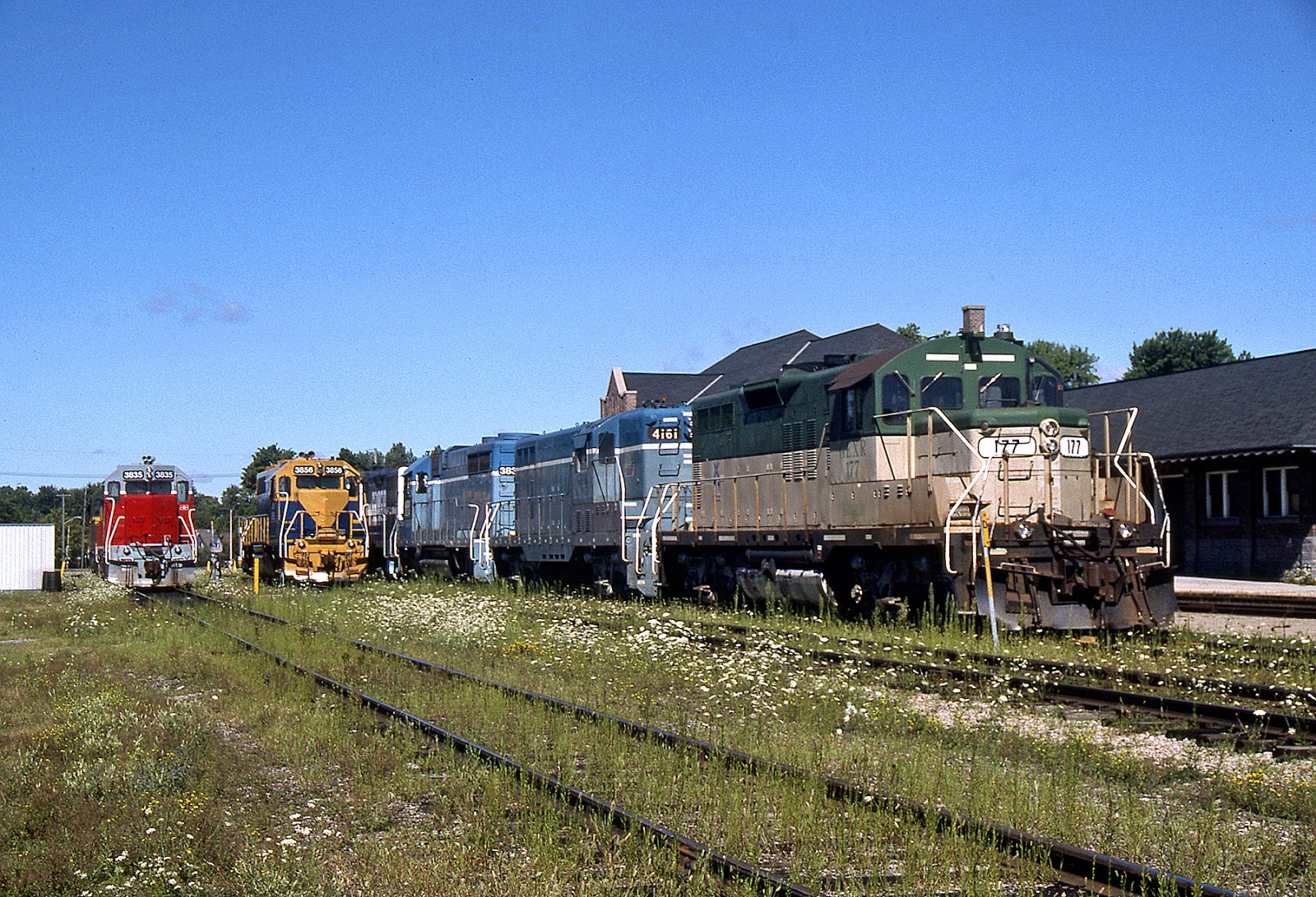
Flashback Friday #30 - Quiet Sunday on GEXR in 1999

An eclectic mix of geeps enjoys a quiet Sunday morning at Stratford, ON, on August 1, 1999. Six paint schemes on seven units - hard to beat that! Gord Taylor photo.


I started writing this yesterday but the day got away from me, so presto-change-o, it’s now a “Flashback Friday” instead of Throwback Thursday (or as CP would say, running slightly late).

I find shortline railroading interesting – shortlines tend to do more switching and grunt work than Class 1’s, usually with smaller crew to boot. Add to that older power cascaded from Class 1’s and many shortlines have a lot to offer for the railfan. The first shortline in Ontario to be operated by an American company was the Goderich-Exeter Railway, operated initially from Stratford to Goderich (with a branch to Exeter) by Railtex. Established in 1992 the railroad featured an eclectic mix of motive power, initially three green-and-cream GMD-built GP9’s from the Cartier Railway in Quebec (each named for characters in Shakespeare plays), bolstered by a host of leased power, particularly in the winter months. Eventually leasing the CN’s Guelph subdivision from Silver (on the Halton sub) to London Jct in London, ON in 1998, the road required more power.

Initially a four-axle only road, the road’s own locomotives were supplemented by other units from other Railtex/RailAmerica roads (RailAmerica acquired Railtex in 2000). Some units were restencilled to GEXR reporting marks, some not; none were painted in the road’s green-and-cream paint scheme, but several wore Railtex’s pleasant red-and-grey paint scheme (e.g. 3821, 3835, 4019, 4022). Early power was primarily GP9’s but quickly more powerful 645-powered EMD’s showed up as the demands of running the expanded railroad meant longer, heavier freights. Eventually, six-axle power arrived with leased SD40-2’s and even a Florida East Coast SD40-2 and later an ex-SP SD45T-2 which remains on the road today. All this contributed to a rainbow appearance to the roster, with numerous paint schemes.

Today the road is operated by Genesee & Wyoming, after it acquired RailAmerica in 2013. G&W’s corporate orange paint scheme has been applied to several units now operating on the GEXR (as always, the roster is in a perpetual state of flux), but the railroad operates much as it has since it’s inauguration.

In the above photo by Gord Taylor, we see the following units on Sunday August 1, 1999:
  • ·        GEXR GP9 #177 (“Titania”); eventually scrapped at Stratford in 2007-2008.
  • ·        GEXR GP38M/slug set #3834/4161 (ex-MP, KCS); eventually scrapped at Goderich.
  • ·        Georgia Southwestern GP9 #2127 (ex-ATSF); eventually scrapped at Goderich.
  • ·    GEXR GP38AC #3856 in NECR colours (ex-NECR 9539, nee GM&O); presently on OVR in G&W orange.
  • ·        GEXR GP38AC #3835 in Railtex paint scheme (nee-GM&O); presently on OVR.
  • ·     Barely visible behind #3835 is GEXR GP40 #4046 in Virginia Southern RR green/yellow (ex-MKT); scrapped in Goderich.


‘Til Next Time,
Cheers,

Peter.

Thursday, 3 November 2016

Throwback Thursday #29 - Bayview Memories (by Keith)

A while back I had a Throwback Thursday about the changes over the years at CN's Bayview Jct, in Hamilton ON. Turns out I 'scooped' my dad who was coincidentally writing a similar article at the same time. So today is part II of our Bayview documentary, written by my dad Keith. 

'Til next time,
Cheers,
Peter.

Bayview Flashback


On a clear mid spring evening freshly painted Canadian Pacific SD40's 5541 and 5514 are about to duck under the Royal Botanical Garden's Laking Gardens pedestrian bridge as they pass through Bayview Jct. and lead the ‘Starlite’ mixed freight towards Burlington, Ontario. The named freight is a carryover from the days of the Toronto, Hamilton and Buffalo Railway, by this date a fallen flag having been fully absorbed by co-parent CP two years previously. Decades-old trackage rights permitted the competitor movement along Canadian National's historic Oakville Subdivision. However, nothing lasts forever and CP's trackage rights would expire approximately twenty years hence.

The right of way that the train is traversing was originally that of the Great Western Railway and dates from the mid 1800’s. In the distant background directly above the lead locomotive is the Desjardins Canal, sadly the scene of one of Canada’s first passenger train tragedies. On the evening of March 12th 1857, as a Great Western passenger train approached the canal  swing bridge, a broken axle on the locomotive caused the consist to plummet some six stories to the frozen waters below. Some fifty nine souls were lost in the calamity, including renowned railway contractor and banker Samuel Zimmerman. A fixed replacement rail bridge replaced the destroyed movable span, preventing the passage of ocean-going schooners through the canal. In time, a consequence of that decision would be the reversal of Dundas’ industrial prominence over Hamilton in the Great Lakes shipping trade. The four-posted highway bridge in the background, known locally as the High Level bridge, was constructed in 1932 by the city of Hamilton as part of a western entrance beautification/depression era unemployment relief program.

In order to accommodate the extra mainline track the width of the supporting berm was increased and then stabilized with a series of piles along the base of the embankment at the water line. Note that the cantilevered signal mast near the cross-overs has been removed in the interim.


While the overall harbor view remains relatively unchanged decades on, the area's railway infrastructure has been substantially enhanced. In 2006 a third main track, extending westward to the junction was added to the harbor side of the existing double track right of way. Currently, in conjunction with expanded GO Train service to Hamilton and beyond, the third main is being extended further westward. Ongoing activity at the moment is focused upon an addition to the bridge structure spanning the historic Desjardins Canal.

As for the locomotives in the lead photo, CP SD40 5514 was built by GMD London in 1966. The unit was upgraded to SD40-2 specifications and equipped with Q-Tron electronics (to enhance tractive effort) prior to sale to the Dakota, Minnesota and Eastern Railroad, becoming DME 6081. The new owner would subsequently upgrade the venerable unit to -3 electronics. In something of an ironic twist, CP would re-acquire the survivor, included in its acquisition of the regional road. Likewise, CP 5541 was also built at the London facility, in 1967. Similarly upgraded to SD40-2 specifications the unit’s fate would be far less auspicious; retired in 2001 and subsequently sold for scrap in 2005.

- Keith.

Mission accomplished. To further stabilize the man made addition, the geographical feature was immediately hydro-seeded. Note the substantial pile structure along the water line. Note also the natural grown in appearance of the vegetation shown in the photo below. Over time, the view (possible photo angles) on one side of the junction has improved, while the other (west side) view has been obliterated all together by the vegetation.


Note the start of some low-level vegetation on the hillside at left - how long until those trees obscure the view again?