The story of CN’s gnarly looking 1200/1300
series SW1200RS locomotive is well known. Between 1955 and 1960 GMD London
would deliver some one hundred and ninety-two of the diminutive road switchers
which were deployed system wide. They could be found in all manner of service
from singular industrial switching to MU’d mainline manifest freights. The
Hamilton based gaggle would initially serve in their intended over the road
role; mainline transfers, out of yard deliveries and the well-known daily way
freight along the former H&NW line south to Port Dover. For decades the
compliment of purpose built MLW S-4’s performed most of the switching duties
associated with the steel city’s vast lake front industrial base. In time, as
the MLW’s were retired, the SW1200RS’s would increasingly assume the switching
activities in and around the Stuart Street yard. Unlike their similarly shaped
MLW S-4 counterparts who were not as fortunate, the 1200/1300’s were subject to
life extending rebuilds and upgrades, making them commonplace for some forty
plus years. While their existence on Canadian National has all but evaporated,
a couple soldier on. Incredibly, No. 7304 (built in August of 1960 as No. 1390)
continues to toil away at the nearby Parkdale steel distribution center. While
not as popular on the aftermarket scene as their larger cousin GP9RM’s, there
are numerous SW1200RS’s in the employ of short lines, industrial operations and
contract leasing and contract switching companies. Considerable time will pass
before they become nothing but museum pieces.
Sunday, 19 July 2020
Sunday, 10 May 2020
CN Rymal Pt. 14 Line Side Structures
With week day way
freight service and as required Saturday extras, the former H&NW (CN
Hagersville Subdivision) branchline was maintained to Class 2 standards;
Maximum 25 MPH (freight). Deferred maintenance and neglect would not be
associated with the track work that remained active well into the late 1980’s.
Like any right of way, all grade crossings needed some form of protection; a
look at the Rymal Road (Highway No. 53) intersection as follows.
| Like all CN lineside cabinets, it was painted standard silver. |
| Note the electrical connection to the hydro pole in the background. |
| The 'DO NOT TRESPASS’ sign is severely weather beaten and would appear to offer rather limited authority. |
| The target (painted red) on the switch stand is marked ‘HA 20’; Hagersville Subdivision, Zone HA, Shaw Pipe (Hamilton Car Control). |
| Crossing protection
flasher mast at Rymal Road (Hwy 53). The cross arms
(cross bucks) have recently been changed from B&W ‘RAIL_WAY CROSSING’ to
reflective red and white. |
Saturday, 25 January 2020
CN Stuart Street Yard – MLW S-4 Switchers
Associated
with the vast adjoining industrial base, for many years CN’s Hamilton Ontario
Stuart Street Yard complex was home to a sizeable switcher fleet, mostly
comprised of locomotives constructed by Montreal Locomotive Works (MLW). Resident
familiar unit into the mid 1980’s was the S-4. Among the more popular of
switcher models to be produced by Alco/MLW, CN’s S-4’s were supplied from 1951
through to 1957. As is well known, MLW’s production mimicked that of parent
Alco; for S-4’s this included a McIntosh and Seymour model 539 prime mover along
with Canadian General Electric (CGE) traction motors and electrical gear. Initially,
from 1949 until 1962, MLW contracted the manufacture of the 539 prime mover to
Dominion Engineering Work (DEW) prior to bringing production in house. CGE
hardware came from Peterborough Ontario. Unlike previous S-1 through S-3
switcher production, both Alco and MLW would modify the carbody, albeit not in
the same fashion. Starting with the S-1, the low height switcher hood featured
the Otto Kuhler design elements of soft bevels and generously curved edges.
During S-4 production, most likely to improve fabrication, the carbody was modified
to include tighter round corners along the length and overlapping ends (Alco)/feathered
edge ends (MLW). MLW took the modification one step further by changing access
door louvers to carbody filters. In total, almost 1,000 S-4’s would emerge from
Schenectady and Montreal (second only to the S-2). See https://www.american-rails.com/705.html
for additional information.
![]() |
| The fate of No. 8169? Online photos show the venerable unit stored out of service in 1986, still at Stuart Street. Note the Dofasco containers at the intermodal facility in the background. |
Sunday, 29 December 2019
CN Rymal Pt. 13: Freight Cars Part 3 - Boxcars
It’s fascinating to reflect upon
how indispensable the commonplace boxcar once was. The rudimentary shoebox on
wheels once carried a myriad of items that are now conveyed by dedicated
purpose freight cars including automobiles (bi/tri-level autoracks), grain
(covered hopper cars), and lumber (bulkhead/centerbeam flat cars). Historically,
the only commodity not routinely shipped in a boxcar was liquids, although
livestock like boxcars were once used to ship barrels of crude oil in 1860’s
Pennsylvania.
The former H&NW line would of
course witness the passage of a variety of boxcar types over the years, both
for on line customers and as part of through/bridge traffic. The included selection
of boxcar geometries, sorted by age, are all of so called ‘double-sheathed’
structure; inside post side construction/steel outer side sheets/wood interior
lining in between the posts. A generational phenomenon, this was the
conventional form of boxcar construction over the build period which stretches
from the early 1940’s to the mid 1970’s. Like all freight cars, boxcars are
subject to AAR Mechanical Designation. Boxcars are ‘X’ Type; the following types
are depicted (from http://www.nakina.net/other/aartype.html):
XL: Loader Equipped Box Car. Similar
in design to "XM", with steel perforated side walls or equipped with
interior side rails for securement of certain types of lading and/or
permanently attached movable bulkheads
XM: Boxcar. A house car for general
service and especially for lading requiring protection from the weather and
equipped with side or side and end doors
![]() |
CN 557420 (XP) was
a 52’-8” long combination door boxcar constructed by National Steel Car (NSC) (lot
P.6340) in January of 1973. By AAR Office Manual Rule 88, unless Rebuilt or qualified
to EXS (EXtended Service) status, this car would have been removed
from interchange prior to the end of 2013 (forty year rule). Freight cars
manufactured after July 1st, 1974 are eligible to continue in
service for fifty years. In conjunction with the EXPO 86 ‘World Exposition on
Transportation and Communication’ held in Vancouver, BC, CN decorated several
pieces of equipment.
See http://tracksidetreasure.blogspot.com/2016/11/cn-expo-86-boxcars.html
for additional information on the specially decorated boxcars.
|
![]() |
CN 557498 (XP) was constructed by NSC
(lot P.6720) in March of 1974.
|
Saturday, 30 November 2019
CN Stuart Street Diesel Shop – Sanding Operations
Tucked in behind the pint-sized diesel shop at the Stuart
Street Yard was a structure common to most locomotive servicing facilities; a
tall, somewhat spindly appearing sand tower.
Traction sand has been a component of railroading ever since the creation of the steel wheel on steel rail combination. Given the inherent low level of contact friction and minute contact area, augmentation of steel on steel traction is essential. Grip for initial movement, smooth acceleration and controlled braking are all dependent to some degree upon proper sanding. Sanding also helps to maintain traction and motion on greasy rail conditions caused by moisture, oil or fallen leaves. Traction sand must be fine, uniform grain, free from contaminants, and most importantly, dry. First generation F units and switchers were typically equipped with four sand fill/hoppers located more or less above each truck side frame. Dick Dilworth’s legendary ‘Geeps’ had a single sand fill located in the prow of each high nose, with internal piping down to each side. Most modern locomotives are similarly configured, although so called ‘safety cab’ locomotives have two fill hatches either side of their wide nose. Delivery of sand to the rail head is accomplished via flexible rubber hoses and nozzles secured to the ends of each truck side frame.
| Blomberg Type ‘M’ rear truck on GP40-2L(W) No. 9468 (GMD 7/1974) |
Saturday, 3 August 2019
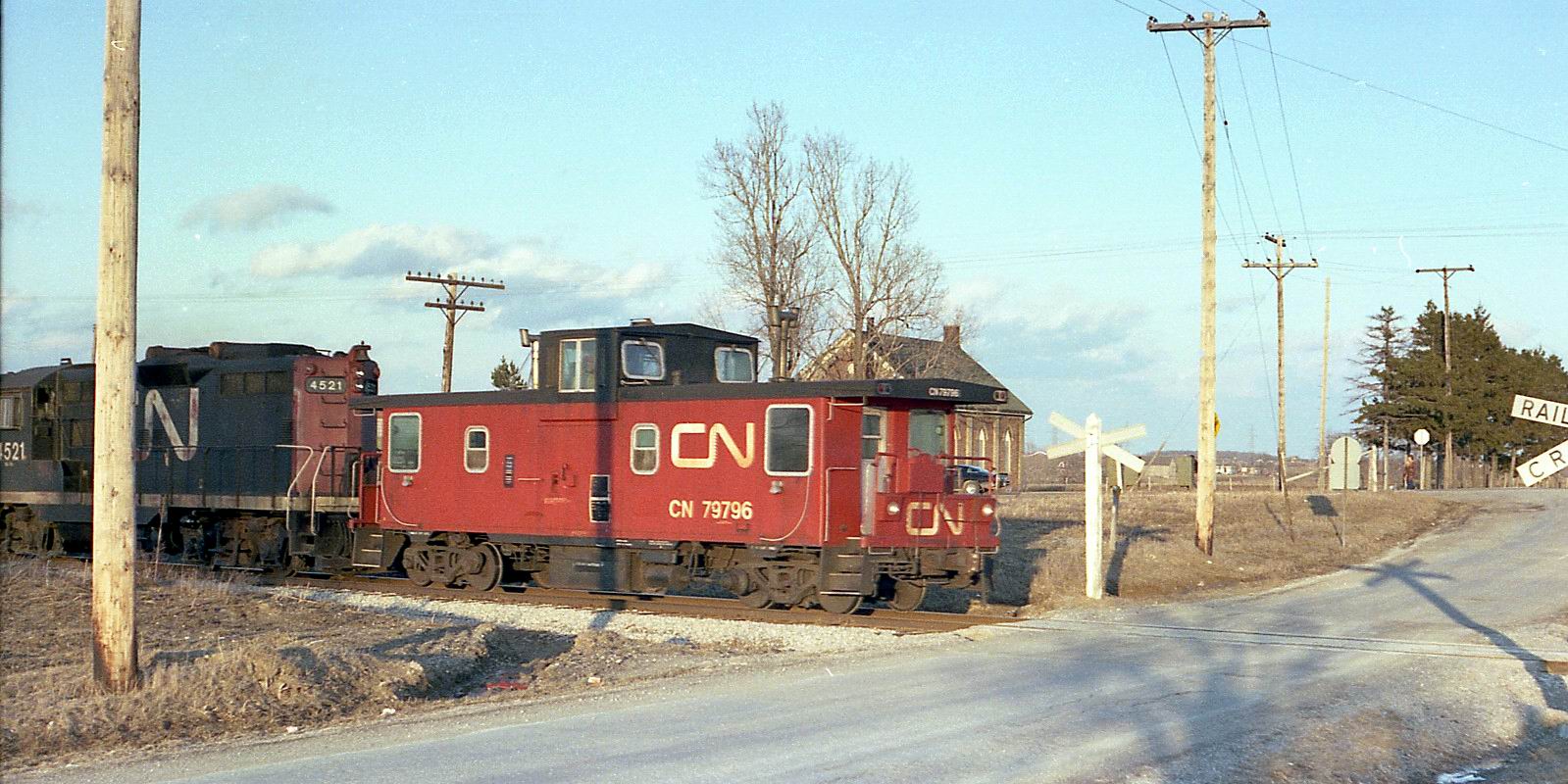
CN Rymal Pt. 12: Caboose Variety Part 1
Like most secondary
operations, the former H&NW line would be home to CN’s well maintained
wooden caboose long after modern steel end of train cabins had been introduced.
Time did eventually catch up with the legendary wooden vans (van; ‘Canadian’
for caboose) and starting in the mid 1970’s they began to be supplanted by steel
bodied successors. While it’s possible that a Hawker Siddeley Transport (HST)
built caboose did traverse the line, it was the well-known Pointe St. Charles
(PSC) that singularly plied the line until the end of service in 1993.
Details of the PSC
caboose are well-known; between 1970 and 1977 CN’s Montreal based
repair/rebuild facility would transform some five hundred and forty eight 1937
built 472000 series forty-foot boxcars into very well appointed crew cabins (CN
79350 – 79897). Exterior features included;
·
Welded cupola with
upward tilted end windows equipped with windshield wipers
·
Large carbody end
picture windows equipped with windshield wipers
·
Large carbody side
picture windows
·
Red/green marker
lights on roof end
·
Clear end sill
mounted backup lights
· Axle driven generators and battery boxes
![]() |
Above:
CN 79866 was constructed in 1977. Based on a guess of a spring 1978 photo date
the shiny orange and black crew cabin is but a few months old. Note the
positioning of the smoke jacks and the air vent directly below the ‘6’, not
included in prior construction (see CN 79444 above). Sadly, CN 79866 was
destroyed in a rear end collision on the Dundas subdivision on May 4th,
1984. CN GP9 No. 4513 was also destroyed (http://www.railpictures.ca/?attachment_id=17206).
Tragically, a crew member in CN 79866 suffered a severe leg injury.
|
Saturday, 25 May 2019
CN Rymal Pt. 11: Freight Cars Part 2 - Shaw Pipe Protection
In addition to the double
ended siding at Rymal, two other spur tracks served local area industries; Penn
Lumber and Shaw Pipe Protection – see Rymal Part 4 (http://rymalstation.blogspot.com/2017/11/cn-at-rymal-part-4.html)
While the Rymal Station stop trackwork dated from the 1870’s inauguration of
passenger service, most likely the additional sidings were constructed in the
late 1950’s as the diminutive local industrial base expanded. This month’s installment
will focus on railway operations related to Shaw Pipe Protection.
Hamilton was and is
known as the ‘Steel Capitol of Canada’; both the Steel Company of Canada
(Stelco) and Dominion Foundries and Steel (Dofasco) once operated major
facilities on the lakefront. Today, only AcelorMittal, owner through
acquisition of Dofasco, continues to produce steel. Operations at the recently
renamed back to Stelco instalation are currently limited to finishing
(galvanizing) and coking.
In its prime, Stelco had
several affiliated area operations including Stelpipe located in nearby
Welland. While the facility manufactured a variety of pipe geometries, their
staple was oil & gas pipe intended for major pipeline construction
projects. Underground pipe requires a protective coating, a process performed
by Shaw Pipe Protection. Formed in 1958, Shaw Pipe Protection Limited would initially
establish coating facilities in Hamilton and Toronto. Proximity to pipe supply
together with rail access combined to make the local hamlet of Hannon an ideal
location for the Shaw facility. A thriving enterprise for some thirty years,
the level of activity would ebb, and flow as major pipeline construction
projects were launched and completed. In 1984 Shaw secured a major supply contract
related to a large-scale pipeline construction project in western Canada. Due
to limited siding capacity it became necessary to switch the Shaw siding twice
a day; in the morning by the daily way freight, in the afternoon by an ‘Extra’
job dispatched from the south. ‘Extra’ weekend switching was also required. Following
the lifting of rails in 1993 activity at the Shaw plant began to decline significantly.
A further blow was dealt in 2005 when Stelpipe was sold off as part of Stelco’s
insolvency. Lack of rail access together with potentially unstable pipe supply resulted
in Shaw having virtually no opportunity to participate in major pipeline
construction contracts. As a result the facility was essentially doomed;
overall operations would cease around 2007. Several years ago the entire infrastructure
was razed and the vacant land remains a brownfield site. While no development
has subsequently taken place on the former Shaw property it appears that the
process of soil remediation is nearing completion. Still a global enterprise, information
on what Shaw became part of, go to https://www.shawcor.com.
Additional information on the history and development of the Shaw corporation can
be found within the obituary of founder Leslie Earl Shaw; http://nationalpost.remembering.ca/obituary/leslie-shaw-1927-2007-1065386407?fbclid=IwAR2eaQy2S0Hct4seJ_TiTlv3-OMFBBdJd0G4T4w1kVdaYwgXSUbjjkUaQnw.
Above:
CN 667407 is a 62 ft. flatcar built by National Steel Car
(NSC) in 1974 as part of series CN 667275 – 667410. The payload consists of
24-inch pipe protected by a 2-Layer Polyethylene
Coating known as ‘Yellow Jacket®’. Yellow Jacket® consists
of a continuous sheath of high-density polyethylene cross-head extruded over a
rubberized asphalt adhesive. Introduced
over half a century ago the protective layer can withstand routine handling and
allows for field bending in temperatures as low as -30°C. Note the adjacent CN
gondola loaded with pipe to be coated.
|
Above: CN 668238 is an 89 ft.
flatcar built by Hawker Siddeley Transportation (HST) as part of a three
hundred car lot (CN 668000 – 668299) in December of 1975. Compared to the
payload above, the pipe appears to have received some type of asphalt or
perhaps rubber-based coating. For pipe protective coating alternatives, go to; https://www.shawcor.com/pipe-coating-solutions/integrated-solutions/pipe-coating/anti-corrosion-protection
|
Subscribe to:
Posts (Atom)